

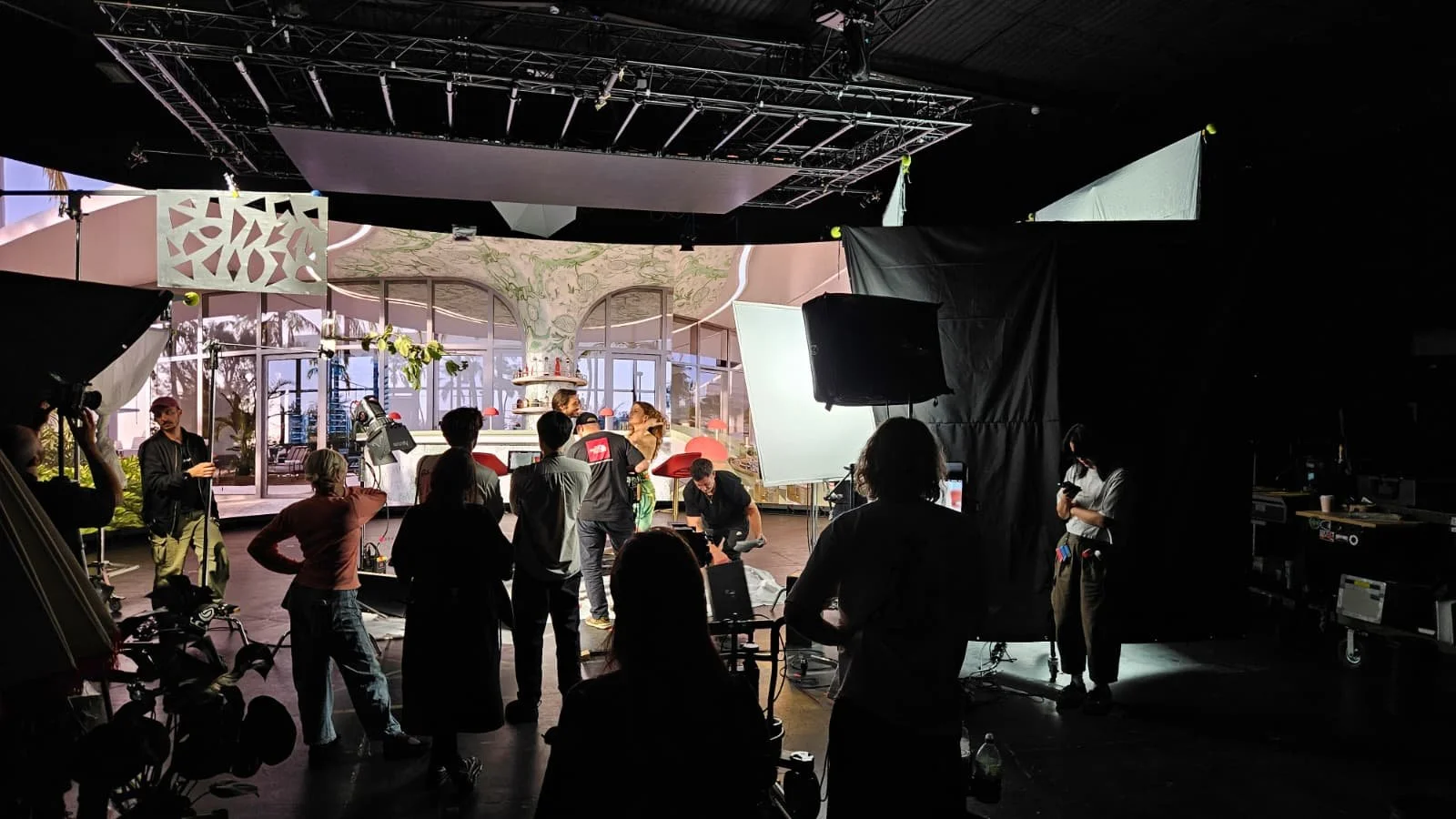
FAENA Residences Miami x Binyan Studios shoot
Virtual production utilising Chaos arena software & Camera tracking
Faena development - Pre-production phase
This shoot felt special from the very beginning. The moment La Paz Films approached us with the brief, we knew it was going to be an exciting project to be part of. What made it even more rewarding was the opportunity to collaborate with an exciting new player in the virtual production space: Chaos Arena.
Chaos Arena enabled us to use the exact same assets as the VFX team without the need to import, convert, and adjust them in Unreal Engine. This significantly streamlined the asset pipeline and provided unparalleled flexibility, allowing our team to build and refine scenes directly in the preferred 3D software, before seamlessly bringing them into the virtual production environment.
The team behind Chaos Arena played a crucial role in making this possible. They provided outstanding support throughout the integration process, assisting us not only remotely but also on set, working alongside our technicians during the shoot. Their expertise and dedication were instrumental in ensuring the shoot ran smoothly and helped us fully unlock the potential of this innovative workflow. It was a real pleasure to be joined on set by Vladimir "Vlado" Koylazov, the founder of Chaos Arena and famously, the creator of V-Ray software!
Production phase - Real time rendering is the key
One of the key factors that makes virtual production believable is the ability to render environments in real time on set. While high-quality assets and detailed environments are essential, they only become truly effective when they can respond instantly to camera movement, lens changes, lighting adjustments, and creative decisions made during production.
As the camera moves, the virtual environment updates immediately, creating accurate parallax and perspective shifts that closely mimic the behaviour of a real-world location. This interaction between the physical camera and the digital world is crucial for maintaining the illusion that the actors are truly inhabiting the environment displayed on the LED.
Beyond visual realism, real-time rendering transforms the creative process itself. Directors, cinematographers, production designers, and VFX supervisors can evaluate shots together on set and make informed decisions instantly. Lighting can be refined, environments adjusted, and compositions can be explored without waiting for lengthy rendering or post-production reviews. This immediate feedback loop not only increases efficiency but also enables a level of creative experimentation that would be difficult to achieve with traditional visual effects workflows.
Ultimately, the success of virtual production depends on making the boundary between the physical and digital worlds disappear. Real-time rendering is the technology that bridges that gap, ensuring that virtual environments behave naturally, react dynamically, and provide both the cast and crew with a convincing world to work within from the moment the camera starts rolling.